
divorce alimony
The alimony arrangements after divorce vary according to the actual circumstances of both parties. You can apply for a spousal or child support order, and choose a lump sum or periodic payment method as needed.
Divorce
Alimony considerations
The award of alimony needs to comprehensively consider the financial status of both parties, the quality of life during the marriage and individual circumstances, and make an assessment based on various factors listed in Article 7 of the Matrimonial Proceedings and Property Ordinance.
Financial needs, burdens and responsibilities
The court will examine the existing assets, income and financial status of both parties, and both parties must disclose their respective financial information, including daily expenses and the cost of supporting family members, in order to make a fair decision.
Quality of life enjoyed by families before divorce
The court will consider the standard of living that the family was accustomed to during the marriage. After separation or divorce, the total expenditure to maintain the livelihood of both parties is often higher than when living together, and the overall quality of life generally adjusts.
physical or mental health condition
If either party has physical or mental health problems that affect their ability to support themselves, the court will also take the relevant circumstances into consideration when determining alimony as one of the important basis for evaluation.


Professional agency, full escort
Applying for alimony requires mastering complex legal provisions. The Hengcheng team will help you clarify your application qualifications, formulate the most appropriate support arrangement strategy, and effectively protect the legitimate interests of you and your children.
Common types of support orders
Choose the most appropriate application method based on your personal circumstances
A "temporary maintenance order" is an order that provides temporary financial support to the applicant pending the issuance of a final divorce decree. Since divorce proceedings often take several months, an interim order can ensure that the applicant receives basic living security until the trial is completed. This order is effective when the final judgment is issued or when one party dies, and the specific amount may also be different from the final judgment.
periodic payment order
Maintenance arrangement with monthly installments
The court can set a fixed periodic payment arrangement based on the actual needs and personal circumstances of the payee. This order automatically terminates when the payee remarries or either party dies. It can also be revised upon application due to changes in the life circumstances of both parties.
guaranteed periodic payment order
Secured regular maintenance arrangement
When there is a risk of default by the payer, the court can issue a regular payment order, using a designated property of the payer as a mortgage guarantee to ensure that the payee can steadily receive the alimony he deserves.
lump sum order
One-time settlement of maintenance arrangements
A lump sum order settles support obligations in a lump sum, or can be paid in installments. Once this order is issued, it is final and cannot be changed in the future, and the money paid cannot be recovered. It is suitable for cases where you want to clearly end the financial relationship.
Property distribution (or transfer) order
Legal arrangements for re-ownership of assets
The court may order one party to transfer his or her interest in the assets to the other party, with the aim of equitably dividing the capital value of the marital assets. This order cannot be changed at will after it is issued, so you should fully understand the possible impacts before applying.
Confinement Arrangement Order
Protect the interests of beneficiaries in the form of trust
A settlement order requires one party to transfer assets to a trustee, who will hold and manage the assets for the beneficiary (the other party or children) in accordance with the terms of the trust. This type of order is relatively rare, and the court will comprehensively review both parties' income capabilities, property holdings and other assets before issuing it.
Change of Confinement Arrangement Order
Application to amend the terms of an existing trust
This order is relatively rare and applies to situations where existing trust arrangements need to be adjusted based on actual circumstances. When reviewing and approving the trust, the court will amend the relevant trust terms or rearrange the transfer of assets.
Divorce fees start at HKD$2,000
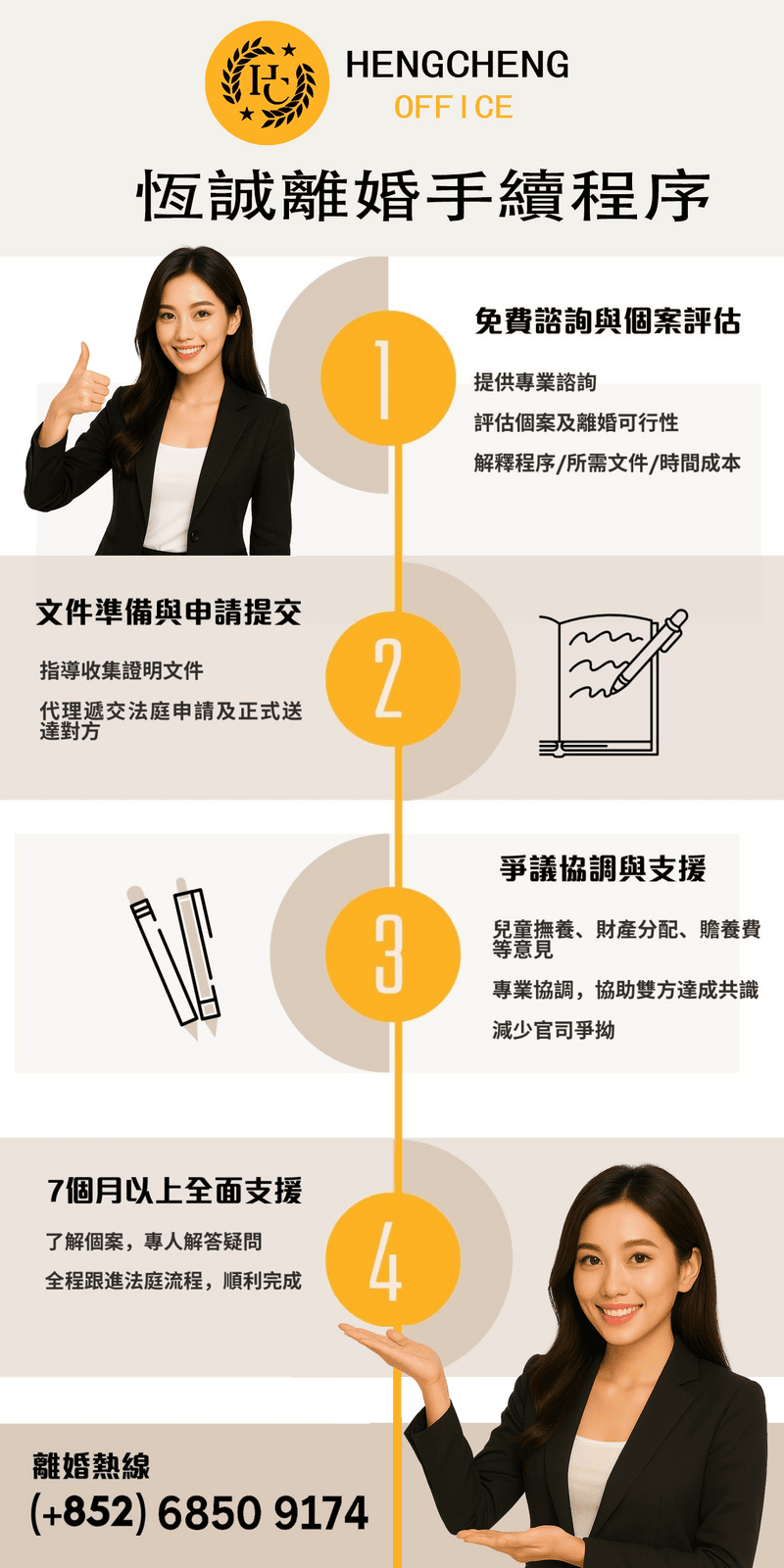
The application process for alimony is complicated, and the determination of the amount involves multiple legal considerations. Contact Hengcheng now to enjoy a free initial consultation and let us evaluate the most appropriate application plan for you.
Drafting a separation agreement
How to apply for custody
Distribution of marital property
divorce application
Apply for alimony
protection order(wardship)
guardianship
Matters concerning children born out of wedlock
Assessment of unreasonable behavior
Change custody order
Matters concerning children born out of wedlock
Provide advice to you if you are required to attend a hearing

Divorce procedures
According to the Matrimonial Causes Ordinance of Hong Kong, there is a time limit for divorce applications. Unless permitted by a special court, under normal circumstances, two people must be married for at least 12 months before they can apply for divorce.
divorce agreement
The divorce petition (also known as the agreement) needs to fill in the personal information of the two people, listing their marriage date, current marital status, previous address of residence, date of separation and each person's address.
custody
The purpose of alimony is to ensure that the normal lives of both parties will not be affected by divorce, so that the party requesting alimony or his or her children can receive financial support and protection.
Divorce between China and Hong Kong
Generally speaking, custody refers to the power to care for and supervise children through a court order. The father or mother who obtains custody after divorce must be responsible for taking care of the children's daily lives and making decisions regarding their children's day-to-day welfare. The court may also grant joint custody.
Frequently asked questions about alimony in Hong Kong
The following is a list of the most frequently asked alimony-related questions from clients to help you understand basic legal concepts before formal consultation. If your personal situation requires evaluation, please feel free to contact us at any time.
If the other party defaults on alimony, how can I recover it?
Applicants can refer to the following methods according to the situation:
Summons for judgment
Applicants can apply for a judgment summons in court.
The court will have the applicant and the other party appear in court, and they will have to prove all the circumstances and money owed. The applicant can pursue the claim at the beginning of the legal proceedings to enforce the payment of the arrears. If the arrears have been overdue for more than one year, the court may refuse to enforce the payment order.
If your spouse fails to pay without sufficient reason, the court has the power to make a new payment order or jail him or her in accordance with section 87 of the Matrimonial Causes Rules. If your spouse repeatedly misses hearings, the court also has the power to sentence your spouse to jail in his absence. However, if the payer pays the debt or makes relevant arrangements, the jail sentence may be suspended.
b. Attachment of income order
According to section 28 of the Matrimonial Proceedings and Property Ordinance, if the court has issued an alimony order to the alimony payer and:
(i) the court is satisfied that the payor has, without reasonable excuse, failed to pay any sum required to be paid under the maintenance order; or
(ii) The court has reasonable grounds to believe that the payer will not comply with the maintenance order and make timely and full payments; or
(iii) both the payee and the designated payee agree to the making of an order under this section; and
any income of the payer which is liable to garnishment,
The court may order that an amount of the payer's income equal to all or part of the amount payable under the maintenance order be withheld, and the withheld amount will be paid to the designated payee from the payer's source of income (such as his/her employer). However, before making the above deductions, the payer may retain a certain amount as his/her reasonable living expenses.
c. Restraining order
You can also apply unilaterally to the court for an order prohibiting your spouse from leaving Hong Kong until the debt is recovered. If granted, the order will be served on the Hong Kong Director of Immigration and your spouse will be refused leave if he/she attempts to leave Hong Kong.
If your spouse frequently needs to leave the country, this procedure will be very effective as it will cause considerable inconvenience to him/her. However, the court may not be willing to restrict anyone's freedom in this way. Therefore, you should only make the above application when other enforcement methods are ineffective or inapplicable.
Can a man ask for alimony from a woman?
Can. When two people apply for divorce and separation, they also have the same rights to obtain.
Under normal circumstances, the man supports the woman, but there is no difference in Hong Kong law. If the woman is capable, the woman must also bear the responsibility. In reality, it is rare for a man to ask a woman for money.
If the other party has a third party, can more assets be distributed during divorce?
Many people think that if the other party is unfaithful to them, the court will favor them and make the result favorable to them. But in reality, the Hong Kong court's position is neutral, if there is really serious behavior. For example, ordinary adultery, beating each other, and not having time to take care of the family are not serious situations.
What is "symbolic alimony"? What's the use after retaining it?
If the woman states that she does not want alimony when applying for divorce, but wants to have the right to claim payment after the divorce, she can applySymbolic alimony order. The order is to pay one dollar every year thereafter, but in reality the payment will not actually be made.
However, the above order can be changed at a later date. Husbands should be aware that if they agree to pay nominal alimony, they may have to pay more alimony in the future. From the wife's perspective, this symbolic order provides her with security as her right to maintenance is preserved rather than completely revoked.
After divorce, can both parties share half of each other’s net worth?
Separate family refers to the amount that can be divided into the entire total assets, including stocks, bank savings, etc., and then the calculated value is calculated according to each item. Therefore, the applicant must agree on the value of each asset, otherwise it will be determined by the court.
The court must then consider whether it is fair or realistic to maintain the current property distribution arrangements, or whether certain adjustments are necessary. In determining any adjustment, the court will consider all of the following factors:
a. Ownership of property
Disputes may arise over the ownership of bank account funds and the use of related funds.
If a bank account is held in the sole name of one of the spouses, prima facie any money in the account belongs to that person, unless there is a contrary intention or the other party contributes part of the money.
If a joint account is used, prima facie, any money in the account is jointly owned by the couple, unless there is a contrary intention (for example, the joint account is opened only to facilitate certain purposes).
Generally speaking, however, any property purchased with funds from the user's account belongs to the buyer.
Therefore, if the husband uses the funds in the joint account to purchase stocks or properties and puts them into his own name, prima facie, these properties belong to him alone. However, if the couple has mixed all the property together and shares it, even if the husband contributes more to the joint account, the court may consider the joint account to be joint property and rule that the property purchased by the husband with withdrawals from the account is owned equally by both spouses.
b. Each party’s place of residence
The court will try its best to ensure that each party has a roof over their head, which is particularly important if they have children. The court will also try to ensure that the children have a secure place to live.
c. Percentage of property available for distribution
Hong Kong courts used to assess the spouse’s “reasonable requirements” and distribute assets based on the relevant assessment. Remaining assets are generally awarded to the person responsible for supporting the family, usually the husband.
However, in the case of LKW v DD (2010) 13 HKCFAR 537, the Hong Kong Court of Final Appeal ruled that the wife is entitled to half of her spouse’s assets upon divorce in Hong Kong.
In cases involving large amounts of assets, this 50/50 rule will have an important impact. Therefore, in Hong Kong, if you want to protect your personal property.
My wife is unemployed and has no financial support for the family. Do I still need to pay alimony?
The court will balance each person's efforts and abilities.
In a relationship, the man is usually the main source of income, while the woman takes care of the household and takes care of the children. The judgment will not be partial to one side or the other.
The court will understand that husband and wife have different but complementary and equal roles in the marital relationship.
Generally speaking, if the marriage lasts for more than three years, the other party needs to pay alimony until the other party reaches the age of 65 or the other party remarries.
How is child support assessed?
a. Types of claims for child support
The parent who has obtained custody has the right to seek monetary support for the children from the second party in each case.
When dealing with alimony matters, the applicant can apply to the court to obtain temporary alimony before the completion of the litigation. After a divorce or separation petition and an application for interim maintenance are filed, the court may make interim financial support orders for the children, such as periodic payments, guaranteed periodic payments and lump sums 。
The court may also make other orders at different stages of the proceedings: (1) at or after the grant of a decree nisi of divorce; (2) during guardianship proceedings concerning a minor; (3) during guardianship proceedings.
b. The upper age limit for children to receive alimony
According to section 10 of the Matrimonial Proceedings and Property Ordinance, the court mayUnder 18 years oldThe children make orders such as periodic payments, guaranteed periodic payments and lump sums.
However, the Ordinance further stipulates that if the child is currently or will be studying in an educational institution, or receiving certain types of training, or under special circumstances that are appropriate and acceptable to the court (for example, the child is a disabled person), payments made in accordance with an existing order may be made.Extends beyond the age of 18 。